


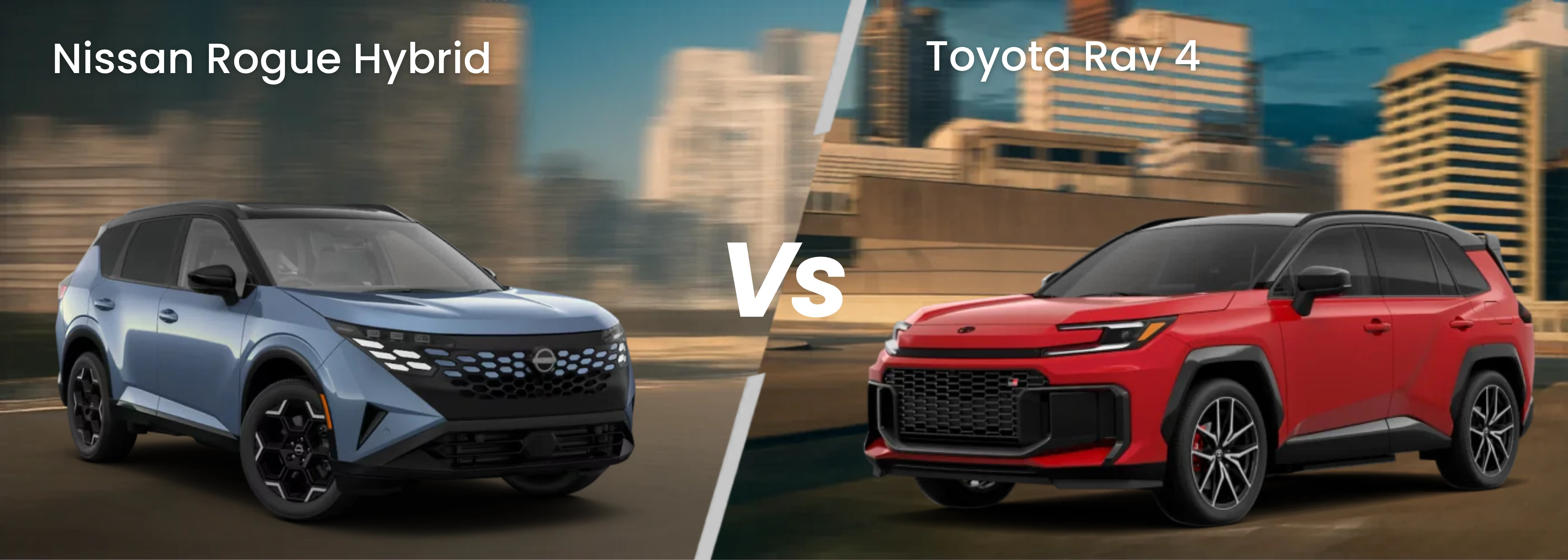
The Toyota RAV4 Hybrid is the best-selling hybrid compact SUV in America — and for years, Nissan had no real answer to it. That changed in 2027. The all-new Rogue Hybrid uses Nissan's third-generation e-POWER system, a technology that makes it the only vehicle in this class that drives exactly like an EV without ever needing to be plugged in. This is the head-to-head comparison Mentor Nissan customers ask about most.
Bottom line upfront: The 2027 Rogue Hybrid wins on driving refinement, standard tech, standard AWD, and an EV-like experience that the RAV4 Hybrid cannot match. The RAV4 Hybrid wins on fuel economy, starting price, and towing capacity. We have 2027 Rogue Hybrids in stock now at Mentor Nissan — Lake County's only Nissan franchise dealer.
The Most Important Thing to Understand: These Are Two Very Different Hybrids
Both vehicles are called "hybrids," but they work completely differently — and that difference matters enormously to how they drive.
The 2027 Nissan Rogue Hybrid uses a series hybrid (e-POWER) architecture: The 1.5L turbocharged 3-cylinder engine never touches the wheels. It runs only as a generator to charge a 1.67 kWh battery pack. Two permanent-magnet electric motors — one on each axle — drive the vehicle 100% of the time. There is no transmission, no clutch, no engine-to-wheel mechanical linkage. It drives like an EV because, mechanically, it is one.
The Toyota RAV4 Hybrid uses a parallel hybrid (e-CVT) architecture: The gas engine assists or drives the wheels directly at highway speeds through an electronic CVT. It is a mature, proven system that prioritizes efficiency but delivers a more traditional driving feel.
Edmunds, InsideEVs, and Autoblog all drove both and reached the same conclusion: the Rogue Hybrid "drives like an EV" with "impeccable refinement," while the RAV4 Hybrid is "the more conventional hybrid" — measurably quieter than it used to be, but still noticeably gas-powered under hard acceleration.
Quick Specs at a Glance
| Spec | 2027 Nissan Rogue Hybrid | 2026/27 Toyota RAV4 Hybrid |
|---|---|---|
| Starting MSRP (incl. dest.) | $37,065 (SV AWD) | $33,495 (LE FWD) / $34,895 AWD |
| Hybrid System Type | Series (e-POWER) — EV-only drive | Parallel (e-CVT) — engine can drive wheels |
| Engine | 1.5L Turbo I3 (generator only) | 2.5L I4 (drives wheels at highway speed) |
| Total System Horsepower | 225 hp | 226 hp (FWD) / 236 hp (AWD) |
| Transmission | None — direct electric drive | Electronic CVT |
| AWD | Standard on all trims — dual motor | Optional (adds ~$1,400) |
| Fuel Economy (combined) | 38 mpg combined (SR trim, EPA est.) | 43 mpg FWD / 42 mpg AWD (EPA) |
| City MPG | Up to 41 city (city driving advantage) | 47 city (FWD) |
| Cargo (2nd row up) | 31.1–34.4 cu. ft. | 37.8 cu. ft. |
| Ground Clearance | 8.4–8.5 inches | 8.4 inches |
| Standard Infotainment | Dual 12.3" screens (14.3" available) | 10.5" touchscreen |
| Hands-Free Driver Assist | ProPilot Assist w/ Hands-Off Mode (SR+) | Not available |
| Towing Capacity | 1,500 lbs | 1,750–3,500 lbs (AWD) |
| e-POWER / EV Drivetrain Warranty | 8 yr / 100,000 mi (entire e-POWER system) | HV battery: 10 yr / 150,000 mi |
| Plug-In Required | Never — gas only, no charging needed | No (standard hybrid) |
Where the 2027 Nissan Rogue Hybrid Wins
- EV-like driving experience — Because the wheels are powered by electric motors 100% of the time, the Rogue Hybrid accelerates smoothly from a standstill with no transmission shifts, no engine-rev surge, no lag. InsideEVs described it as "impeccable refinement." Edmunds confirmed it "feels most like an EV." The RAV4 Hybrid is smooth for a parallel hybrid — but it is still a parallel hybrid, and the difference is felt.
- Standard AWD on every trim — Every 2027 Rogue Hybrid comes with dual-motor AWD at no extra charge. The base RAV4 Hybrid starts FWD; AWD adds approximately $1,400. For Northeast Ohio winters, this is a meaningful advantage with no cost penalty on the Rogue.
- Larger standard technology screens — The Rogue SV comes standard with dual 12.3-inch displays. The RAV4 Hybrid offers a 10.5-inch touchscreen standard (12.9-inch on higher trims). The Rogue's optional 14.3-inch dual displays are the largest in the segment.
- Hands-off ProPilot Assist — The SR and SR Technology trims add ProPilot Assist with a Hands-Off Traffic Jam Assist mode — the only system in this class that offers hands-free driving in bumper-to-bumper traffic. The RAV4 Hybrid has no equivalent at any trim level.
- 8-year / 100,000-mile e-POWER system warranty — Nissan covers the entire e-POWER drivetrain — including the battery, motors, and generator — for 8 years or 100,000 miles. This applies to every component that makes the car a hybrid, giving Ohio buyers long-term peace of mind.
- One-pedal driving + Smooth Stop technology — The Rogue Hybrid offers genuine one-pedal driving via e-Pedal mode, with Nissan's proprietary Smooth Stop algorithm that prevents the head-toss common in other one-pedal systems. This is an EV convenience in a gas-station-fueled package.
- Invisible Hood View surround camera (SR Technology/Platinum) — The 3D HD Enhanced Intelligent Around View Monitor includes an Invisible Hood View feature that shows what is below and in front of the hood — extremely useful for parking on curbs and navigating tight spaces. The RAV4 offers a surround camera but not this feature.
- AMCI-certified best-in-class braking — Nissan's own AMCI testing certified the Rogue Hybrid has the shortest 60–0 braking distance in the compact hybrid SUV class — shorter than the RAV4 Hybrid and the Lexus NX 350h.
- Physical climate controls retained — Nissan kept physical buttons and toggles for HVAC, volume, and defrost rather than burying them in a touchscreen. Multiple reviewers praised this as an advantage over competitors that have moved everything behind glass.
Where the Toyota RAV4 Hybrid Wins — Honest Assessment
- Starting price — The RAV4 Hybrid LE starts at $33,495 (FWD) or $34,895 (AWD) — roughly $2,000–$2,500 less than the Rogue Hybrid SV AWD at $37,065. If budget is the primary driver, the RAV4 is the lower-entry point.
- Superior fuel economy — The RAV4 Hybrid AWD achieves 42 mpg combined (EPA), versus the Rogue Hybrid's 38 mpg combined. On a pure miles-per-gallon basis, the RAV4 wins — especially on the highway, where the Rogue's series architecture is less efficient than the RAV4's parallel system.
- More cargo space — The RAV4 offers 37.8 cu. ft. of cargo space with the rear seats up, compared to the Rogue Hybrid's approximately 31–34 cu. ft. This is a meaningful difference if cargo capacity is a priority.
- Higher towing capacity — The RAV4 Hybrid AWD is rated to tow up to 3,500 lbs — more than double the Rogue's 1,500 lbs. If you tow a trailer, boat, or camper, the RAV4 is the clear choice.
- RAV4 Prime (PHEV) option — The RAV4 Prime delivers 302 hp and up to 42 miles of electric-only range on a charge. No plug-in Rogue equivalent exists in this configuration.
- Proven long-term reliability data — The RAV4 Hybrid has been on sale since 2016. There are years of real-world reliability data, ownership history, and resale value records. The 2027 Rogue Hybrid is brand-new — its long-term track record is yet to be established.
- Off-road Woodland Edition — Toyota offers a Woodland Edition with Multi-Terrain Select modes and upgraded ground clearance. No Rogue Hybrid equivalent exists.
e-POWER Explained: Why the Rogue Hybrid Drives Like an EV
The 2027 Rogue Hybrid's e-POWER system is now in its third generation and has been sold in nearly 2 million vehicles worldwide since 2016 — but this is its first appearance in the U.S. market, purpose-built for North American highway driving conditions.
Here is what makes it different from every other hybrid on sale at a Nissan dealership today: the 1.5L turbocharged 3-cylinder engine never, under any circumstances, turns the wheels. It operates only as a generator — running at approximately 2,000 rpm in its most efficient power band — to feed electricity to the battery pack and the two permanent-magnet motors. Those motors drive the front and rear axles independently. Because there is no transmission, no clutch, and no driveshaft between front and rear, acceleration is linear, instantaneous, and completely seamless in a way that no parallel hybrid can replicate.
The trade-off is highway fuel economy: at sustained highway speeds, the RAV4 Hybrid can lock its engine directly to the wheels for maximum efficiency. The Rogue Hybrid cannot. That is why the RAV4 leads in combined EPA ratings, and it is worth acknowledging honestly.
But for the driving conditions most Ohio commuters face — stop-and-go on I-90, surface streets in Mentor and Willoughby, mixed suburban driving — the Rogue Hybrid's city-biased efficiency and EV-smooth acceleration are a genuinely compelling argument.
Which Should You Buy?
Choose the 2027 Nissan Rogue Hybrid if you want the most refined, EV-like hybrid driving experience in the class, standard AWD with no upcharge, the largest standard tech screens in the segment, and Nissan's industry-leading 8-year e-POWER warranty. It is the right choice for buyers who have driven an EV and love it, but do not want range anxiety or a charging routine.
Choose the Toyota RAV4 Hybrid if you want maximum fuel economy in a proven, battle-tested package, need to tow over 1,500 lbs, want more cargo capacity, or prefer the lower starting price. The RAV4 Hybrid is an excellent vehicle — it won that class for a reason — but the gap has closed dramatically with the 2027 Rogue.
Mentor Nissan is Lake County's only Nissan franchise dealer, located at 6960 Center St in Mentor, OH. We have 2027 Rogue Hybrids available now. Call us or stop in and we'll put you in one for a drive — the e-POWER difference is something you have to feel.
Finance the 2027 Rogue Hybrid at Mentor Nissan
Apply for financing online, check current Nissan lease deals, or value your trade before you visit. Credit concerns? Our finance team works with all credit profiles.
Frequently Asked Questions
Does the 2027 Nissan Rogue Hybrid need to be plugged in?
No. The Rogue Hybrid is not a plug-in hybrid. You fill it at any gas station like a conventional vehicle. The e-POWER system manages its own battery charging internally — no home charger or public charging is required or possible.
Is the 2027 Rogue Hybrid available with AWD?
Yes — and AWD is standard on every single Rogue Hybrid trim. There is no FWD option. This is a meaningful advantage over the RAV4 Hybrid, where FWD is the base configuration and AWD adds cost.
What is the warranty on the Rogue Hybrid battery and drivetrain?
Nissan covers the entire e-POWER drivetrain — including the battery pack — for 8 years or 100,000 miles (whichever comes first). This covers every component that makes the Rogue Hybrid a hybrid.
How is the 2027 Rogue Hybrid different from the Rogue PHEV?
These are completely different vehicles. The Rogue Hybrid (e-POWER) is Nissan's own technology, purpose-built for North American driving. The Rogue PHEV is a rebadged Mitsubishi Outlander PHEV — a plug-in hybrid with a different architecture, a different warranty, and no e-POWER system. If you're at Mentor Nissan asking about the Rogue Hybrid, you want the e-POWER model.
What is the starting price of the 2027 Nissan Rogue Hybrid?
The 2027 Rogue Hybrid SV AWD starts at $37,065 including destination. The SR trim starts at approximately $39,065 with destination, and the Platinum tops the line near $45,065. All trims include standard AWD.
Also Compare
- 2027 Nissan Rogue Hybrid vs. Honda CR-V Hybrid
- 2027 Nissan Rogue Hybrid vs. Kia Sportage Hybrid
- 2027 Nissan Rogue Hybrid vs. Hyundai Tucson Hybrid
- 2027 Nissan Rogue Hybrid vs. Chevrolet Equinox EV
- New 2027 Nissan Rogue Hybrid — Mentor, OH
- Current Nissan Lease and Finance Deals
- Nissan Certified Pre-Owned — 167-point inspected, factory warranty